Month: September 2014

IBM’s co-investment in training cuts salaries by 10%

Just saw that IBM is cutting salaries 10% for employees in the Global Technology Services strategic outsourcing group who have been identified as not keeping their skills current. For the next six months, identified employees will spend a day a week getting current on their skills. IBM is calling this program a “co-investment” in training. (See the full article at Computerworld.)

So, it’s pitched as a way to help employees who are falling behind. Employees spend 20% of their week in training and their salary is reduced by 10% (assuming they are working five day weeks for eight hours a day). Critics and cynics suggest it’s a way to weed out certain employees without having to pay severance. Or maybe it’s just a new way to reduce the salary budget for six months?

So many questions:

  • Was this a long time coming or just dropped on employees one day? How was well was it communicated?
  • How did IBM determine who was lacking current skills and which skills were lacking? Are those skills needing to be brought current actually required in the daily work of those who haven’t kept up?
  • Have training budgets or programs been cut in the past five years? Did everyone have equal opportunity for development?
  • What have those who are deemed current done differently than those who aren’t? How did they stay current? Was it through seeking training on their own time or was it on-the-job training from working on new projects?
  • Were those skills and the level of mastery needed made explicit before / after the pay cut?
  • Who is providing the training? How is it being paid for?
  • Why is the program six months long for everyone? Is everyone lacking the exact same amount of skills?
  • Has the workload of participating employees also been reduced to allow for the day of training?
  • How will the skills and mastery be assessed before reinstating pay?
  • What happens if a person doesn’t reach those levels? Are they fired, do they continue training, etc.?
  • Has IBM just handed everyone an excuse for not working more than 40 hour weeks: “I’d love to stay and work longer, but I need to keep current.”
  • What will be the impact on the morale of all employees?
  • Is this – as some commented – an subterfuge to “encourage” certain employees to quit or a clever way to help trailing employees get back up to speed?
  • What will be the next company to do this?

What thinks you?

can I get a little hate?

I’m fascinated by branding. Not the marking-cows-so-the-don’t-get-rustled kind. The kind of branding that’s about identity and messaging and clear authenticity. How clear? If No One Hates You, No One is Paying Attention. That statement is the title of a great piece by Alf Rehn (@alfrehn), and gets at the heart of branding. Alf reminds us that trying to be all things to all people doesn’t work, despite the legions of businesses that attempt it. It makes sense to know and declare who you are as a business and what you stand for. But the ugly, unmentioned downside is that in doing so you are also declaring who you aren’t and who you stand against.

So truly strong branding is only telling people “Our products are for you. You will like them. You will like what being associated with them says about you. You should buy them.” But it’s also taking that stand to say “Our products are not for you. You won’t like them. You won’t like what being associated with them says about you. You shouldn’t buy them.”

As an example Alf mentions the Cadillac “Poolside” ad. I hadn’t seen it, but it apparently launched in the spring to much criticism. Take a look:

Critics said it missed the mark, because it was obnoxious, reinforced negative stereotypes about Americans, and didn’t appeal to most buyers. Which was the point. They took a bold stand in defining who their target customers were and who they weren’t. It also got people talking and passionately arguing about Cadillac and what the ad represented. And it presented their electric cars a cool status symbol for people who would typically abhor electric cars as being for “tree hugging ecomentalists”.

Ford took advantage of the Cadillac’s self-induced negative press to parody it with an ad targeting a completely different group of buyers. Think young urban activist vs middle aged Wall Streeter. It’s a brilliant parody, nailing scene after scene and positioning buying the Ford as almost an act of protest against everything the Cadillac buyer stands for. It’s a pretty good jab, but not quite as much of a statement simply because the Ford has a bigger target market and the ad doesn’t have the same level of potential for starting internet flame wars.  See it here:

Not as bold as it seems

These ads actually highlight how low the bar for a definitive brand is set. That the ads appear buzzworthy is incredibly telling. This isn’t edgy – it’s actually very safe because it’s just acknowledging and reinforcing their long established brand images. The people who liked it were already on board and those who got irritated never going to be customers anyway. All the marketers have done is acknowledge and play off of what was already there.

Middle-age folks with some bucks treating themselves with a luxury car because “they’ve earned it”? Not quite a shocker. Twenty-somethings buying a small economy car? Well, few among that market could afford the luxury brand even if they did want it. Safe. Safe. Amusing. But safe.

Why are we so concerned with clearly defining our brands? Why are we so worried we might offend a potential customer when those who might be put off by the brand were never going to buy from us anyway? Why do we so rarely define both our target market and our anti-market? Our brand and our anti-brand? (A fun question for my HR friends: What’s the brand and anti-brand for your HR department? If you can’t answer that you might want to start asking around because it exists whether you’ve defined it or not.)

Bolder branding?

You know how difficult it is to shake the reputation you establish in the first few weeks on a job? Branding is the same. The brand image can boost or haunt you for years to come. So one of the biggest challenges is changing a brand by creating a new and different identity. The risk is that you’ll offend and lose the existing demographic while not convincing anyone of the new brand. Some retailers, such as JcPenney have been giving a master class in how not to change your brand for the past couple of years.

We started off with cars, so let’s continue there. Jaguar has been one of the most interesting rebrands to watch. They had a huge sporting heritage in the 1960s and then slowly morphed into an old man’s brand for people who liked luxury cars that tended to leak oil and break down on the way to the country club. Unfair? Tough. That’s the unfortunate power of branding. Your brand is not what you want it to be, it’s the identity and image stuck in the customer’s mind. And that can be tough to overcome.

A couple of years back they attempted to change their image with ads like this:


That’s a pretty swift kick to the crotch of the traditional buyers. Then, more recently they switched to the Good To Be Bad campaign with ads like this:

Are they good cars? Don’t know. But the branding has taken a bold, fun, tongue-in-cheek stance with a middle finger (or two fingers upraised) to the stodgy past. These are not cars for everyone. More importantly, judging by the styling and dragster-meets-F1 car sound, they are not cars for Jaguar’s traditional customer.

But they are cars for who they want their new customer to be. They have a very clear idea of who that is and isn’t.

Do you?

Everything you think you know about success is wrong (a book review)

Success is how you define it and mediocrity is one of my biggest fears. We all have different definitions of what success means to us in all aspects of our lives. I have some big ideas about the contribution I need to make before I leave this planet and the thought of not living up to those ideals terrifies me.

The challenge is that “pretty good” is a reasonably easy target while “extraordinary” requires a completely different level of choices and commitment. And those actions have to exist in a life where there’s a job, family, friends, pets, house chores, hobbies, etc., etc. No surprise that comfortable distractions are a lot more attractive than committed actions.

As one who enjoys anything that will help me be at my best, I have a love/hate approach to personal development books. Much of it is syrupy feel-good nonsense, but some is very legit and useful. The problem is, even the good stuff is usually just repackaged ideas that have been around for the last 50-100+ years.

Some very large names in the field have done quite well rehashing ideas from Napoleon Hill’s Think and Grow Rich, Dale Carnegie’s How to Win Friends and Influence People, Norman Vincent Peal’s The Power of Positive Thinking, or Earl Nightingale’s The Strangest Secret. Tony Robbins summarized the wisdom of the ages best with his Ultimate Success Formula which goes something like: 1) Know what you want; 2) Know why you want it; 3) Take massive action; 4) Notice what’s working or not; and 5) Change your approach until you get your results. Simple, straightforward, and intuitive, but perhaps not sufficient. No one who’s made it to adulthood should be surprised by any of those steps, yet most of us are still stuck in ordinary.

The title for this review comes from the back cover of Dan Waldschmidt’s (@danwaldo) book EDGY Conversations: Get Beyond the Nonsense in Your Life and Do What Really Matters. He takes a different approach and asserts that goals, hard work, and tenacity are not enough because we are our own worst roadblock. Our beliefs and behaviors, excuses and justifications keep us in comfortable mediocrity. Truly rising above, standing out, and making a difference requires a completely different level of commitment, thought, belief, and action.

“Because success isn’t about knowing more, It’s about being more… The reality is that you already know what to do… The real question is, what will you do about it? Who will you choose to become.” – Dan Waldschmidt

Contrary to what the infomercial experts and hope pushers tell us, Dan wholeheartedly acknowledges that the whole being extraordinary thing is really freakin’ hard. Knowing what to do is easy; actually doing it is miserably difficult. The movies make it look simple, right? A three minute montage with some upbeat music in the background and suddenly the underdog is a martial arts winning, freestyle rapping, marathon running, dance champion with a Harvard degree and a thriving side business bootstrapped into a global powerhouse. But in real life it comes down to who we are choosing to be and the decisions we are making every day.

The author reminds us that outrageous success comes as much from what we say “no” to as it does what we say “yes” to. And in our instant gratification you-deserve-to-have-it-all marketing saturated world, saying “no” is weird. And painful. And miserable. And necessary.

This book is the author’s approach to breaking past ordinary. His formula is based on the acronym EDGY: Extreme behavior, Disciplined activity, Giving mindset, and Y(h)uman strategy. The last letter’s a stretch, but the writing is spot on. Actually, I could have shortened this review to: If you like his blog, buy the book.

If you’re unfamiliar with his blog, check it out here. Dan’s not into business or life as usual and has a contrarian approach written in direct one and two sentence paragraphs with brilliant turn of phrase and a deep belief that the reader has it in them to be amazing. If you don’t like his blog, you really won’t like his book. If you like the blog, you’ll find he brings powerful examples and a very human vulnerability beyond his normal writing to the book.

So here’s the ugly secret truth: life is so much easier when you have excuses or others to blame for not creating the results you want. Sure, you don’t accomplish what you want, but you get to be comfortable in your mediocrity. This book is aimed at stripping those illusions away and challenging you to set that comfort aside to pursue your intentions with the ferocious, relentless tenacity of a Spartan warrior. It’s not wondering what to do, it’s not creating a 10 point success checklist, it’s being the person you need to be.

All day, every day.

creating a more human business (book review of “the happy manifesto”)

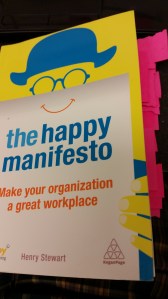
20140903_140729

I marked a few important pages…

Like it or not, the future of work is here

The future of work excites me, fascinates me, and frustrates me. Work as we know it isn’t really working anymore. Work is designed as though people are interchangeable machines instead of being designed to help people be at their absolute best. It’s designed around outdated ideas on when and where and how work MUST be done. It’s based on the (profoundly, incredibly stupid) idea that the boss is the supreme expert in all things work getting things done through apathetic, incompetent minions. We’re doing 21st century work based on ideas developed in the industrial revolution.

People aren’t cogs, people are the point. Business gets done for, through, and by people. I can’t say it enough. It’s common sense obvious. Employees are people, customers are people, vendors are people, managers are people, CEOs are people. Yet, the simple idea that designing business for people (humanizing business) leads to better results is somehow radical. Those too-crazy-for-business-school ideas exist and thrive in organizations that let them.

The thing is, we know better and it’s changing. The future of work is here, examples exist now. Companies like Zappos get attention and flak for challenging the status quo, doing things their own way, and building the company around customers and employees. So many pundits and analysts dismiss the challenges to business school models as trendy fads or unworkable if you aren’t Google, ignoring the under-the-radar examples that have been too busy succeeding for decades to be bothered to care what critics think.

One of those businesses is Happy Ltd., an IT training and e-learning company repeatedly recognized as one of the 20 best places to work in the UK, with accolades and awards from Management Today, Financial Times, and the Great Place to Work Institute. How? Henry Stewart (@happyhenry), the company’s founder, shares his not-so-secret secrets in: the happy manifesto: Make your organization a great workplace (available in free and discounted versions through Henry’s website or at amazon.com).


Answers right in front of me

In so many ways it’s the type of book I’ve been looking for and it has been sitting on my bookshelf for at least a year and a half. The publisher had originally asked if I’d like them to send me their catalog to see if there were any titles I’d like to read and review Of course, there’s only one answer to that question and I quickly read and enjoyed Marianne Cantwell’s Be a Free Range Human but the happy manifesto sat unread. I enjoyed and got so much out of this book that it hurts I ignored it for so long. Sigh.

“That is what this book is about. Its aim is to help you, throughout your organization, to put in place the structure to make that freedom and trust possible.” ~ Henry Stewart

The book based on the author’s 20+ years of experience running his own company based on the principles described. He writes in a clear, straightforward way and provides real-life examples. The author shows what worked, what didn’t, asks some painfully thought provoking questions, and replaces conventional business methods with approaches so radically common sense they seem counterintuitive. I’ll highlight a few here.


Get out of the way

Many people have observed that the best thing leaders can do to enable people to work at their best is to set clear expectations and then get out of the way. Easier said than done for most leaders. How far out of the way? How about “pre-approving” ideas by giving the team full permission to implement their proposals without the leader reviewing it? How about the leader completely removing themselves from the approval process and ensuring they don’t see (and interfere) with new ideas until they are well established? How about removing blame and creating structures that encourage innovation? How about encouraging disobedience?

“Generally I try to avoid telling people what to do but, if I do, I know there is a fair chance the member of staff will do something completely different anyway, if it seems a better way to help the customer or achieve the result that is needed.” ~ Henry Stewart


Create ways for employees to say “yes”

People need to know what is expected and where the boundaries are yet rules often turn into all the reasons an employee can’t help a customer or get things done. Using systems based on principles versus unyielding rules and policies can give people the freedom to solve problems and move things forward. How often do we see rules are put into place to prevent problems caused by a small percentage of people instead of helping the vast majority be at their best? On the flip side, how often do we trust expect the people doing the work to find the best ways to get the job done?

“A rule has to be obeyed. In response to a rule you are expected to suspend your judgement. A system is the best way we have found so far to do something. If any member of staff can think of a better way in the situation they are in, they are encouraged and expected to adapt the system.” ~ Henry Stewart


Get rid of the things getting in the way of great work

Research shows (again and again) that organizations which are great workplaces are more financially successful. Interesting then that creating a great workplace isn’t a priority and expectation for maximizing shareholder value. I’m a firm believer that the customer experience will never exceed the employee experience (I wish I knew who first said that). It makes sense yet organizations rarely focus on the employee experience.

The author shares an interesting twist on Maslow’s Hierarchy of Needs he refers to as “a management hierarchy of needs”. Among all the needs Workplace Safety and Comfort is at the bottom with Freedom at the top. What stands out to me is how little effort we make in organizations to meet all the levels of this hierarchy. It’s as though we meet the most basic of needs and declare it a job well done (and wonder why engagement levels are so painfully low).  AND just as Self-Actualization is unsustainable and meaningless if our basic physical needs aren’t met, trying to create Freedom at work without meeting all the other needs first is unrealistic and primed to fail.

First, are your people’s basic needs being met? Have you asked them what gets in the way of doing their job well? Second, what are you doing to engage people’s higher motivations?” ~ Henry Stewart


Seeing clearly

Transparency is becoming a bit of a buzzword, but how many take it to heart? How many organizations make everything available to everyone? Company financials? What would happen if everyone suddenly had the information they need to make decisions, understood why and how financial decisions are made, and those decisions were transparently exposed to all?

What about [gasp, shudder] salaries? Are your salary decisions fair, unbiased, unprejudiced, and reflective of the value a person creates for the organization? If the answer is “no” you have bigger problems than people simply knowing each other’s salaries.


How important is hiring at your company?

Your company has probably stated that “people are our most important asset” or some such. Sounds good, but… How big of a stand is your company willing to take on that principle? The software company Valve famously made this statement in their employee handbook: Hiring well is the most important thing in the universe. Nothing else comes close. It’s more important than breathing. So when you’re working on hiring – participating in an interview loop or innovating in the general area of recruiting – everything else you could be doing is stupid and should be ignored!

How important are people to your company’s success? How important is hiring on future results? What’s the cost of a bad hire? How much effort is put into training hiring managers and selection teams? It seems like so many companies are happy to have warm bodies OR hold out for perfection based on a wish list of “requirements” that is largely irrelevant to a person’s ability to do the job (e.g., requiring a degree, any degree). From my observation, few give hiring the emphasis it deserves.

Are you able to prove they have the skills and ability to do the job or does your selection process only highlight their ability to interview well? There’s a big difference between being able to talk a good game about doing the job and actually delivering. Are you able to determine how well they will enhance and support those around them?

Do you have an easy way to reach out to the most interested people whenever you have an opening (hint: a post and pray approach doesn’t count)? Do you have a ready list of people interested in working for you as soon as a position comes open or do you make everyone apply even when there isn’t a job so “they’ll be in the system”? Are you surprised when they don’t?


“Profits are important and necessary but not sufficient.”

He’s preaching to the choir here (What’s the Purpose of a Business?) How differently would business be organized and conducted if it were based on the idea that profits are a means, not an end? How much better would organizations be at creating profits if they had all their employees fully behind the meaning and purpose of the work they were doing?

“I’m in business to make a profit. Of course I am. But I’m also in business to make a difference. Otherwise what is the point?” ~ Henry Stewart


Leaders should be good at leading (for a change)

Promoting the most technically skilled people into management roles and expecting them to be immediately and naturally good at leading would be a completely unbelievable and ludicrous idea, except it’s pretty much a given. Everywhere. It’s patently ridiculous yet is The Way Things Are Done.

Running counter to this, the author’s company divides management into two functions: 1) strategy and decision making which is handled by elected department heads; and 2) supporting, challenging, and coaching which is done by coordinators. These may be the same people or may be different and employees have a say in who their leader is. It sounds weird and it completely flies in the face of the more traditional “promote the most skilled and who cares if they can manage others” approach, yet it seems to work for them.


And that’s really it, isn’t it?

We can argue Happy Ltd.’s approaches, ridicule them for being unfamiliar or seeming unrealistically idealistic, yet… it works for them. That doesn’t mean it will work for everyone in every situation, but I get excited because it if works in one place, it just might work in others.

So the question isn’t, Does this approach work? The question is How can I put his approach to work in my team / department / organization?

new socks: the last post you ever need to read about Zappos

I ordered several pairs of running socks from Zappos last night and am pretty jazzed about it (it’s the little things that make a good life, right?). After I clicked the purchase button, it struck me – why are there any articles written about Zappos?

The internet is awash with articles and posts about the online shoe store, but why? Yes, they operate differently, but it’s not like it’s hard to figure why that difference works so well. Zappos makes it supereasy to purchase a huge variety of shoes, etc. at reasonable prices with zero risk that it won’t fit or you won’t like it, and deliver them quicker than should be possible. If anything does go wrong, they immediately bend over backwards to more than make it right. Their entire company – every process and system and policy – exists to enable a great customer experience and somehow the business world is surprised that Zappos has an enthusiastic (fanatical?) customer base lining up to give them money. Who knew that people might want to do business with a company that treats them well?

Are we in the business world truly that thick?

But what about their culture?” some might ask. “They have a unique culture and are so successful, shouldn’t we try to figure out how to copy them? What about all their employees with blue hair coming to work in their pajamas? That’s weird isn’t it? Shouldn’t all us business and HR types be discussing how awesome/strange/wonderful/it-will-never-work that is? Shouldn’t we be desperately trying to figure out how to bring the Zappos culture and magic into our workplaces?

As near as I can tell with my very low level of expertise (I once toured their HQ and I have bought some stuff from them), their unique culture and the unique results it creates is based on two things: 1) customer experience is everything; and 2) the customer experience will never exceed the employee experience (they don’t say it that way, they just live it). They commit to hiring great people who want to provide an amazing experience for customers and then create a work environment where those employees can and are expected to do just that. Create a great employee experience and the employees will create a great customer experience.

It’s an embarrassingly simple and devastatingly, disruptively effective approach. And, most businesses predictably ignore it. Puttnam’s Law tells us it’s better to fail doing what everyone else is doing than to succeed by doing different.

Sure, we could build a business around the customer and employee experience. Or, we could just keep on doing what we’ve been doing, keep getting the same results, and read some more articles about what Zappos.