HR

HR – where it stops and starts

I don’t reblog much, but can’t resist passing this along. Enjoy!

is learning about performance?

Sukh Pabial (@sukhpabial) over at Thinking About Learning (he writes good stuff – check him out) raised an important question the other day: Is learning about performance? As one who continually states that increasing performance is the only purpose of training, learning and development, etc. I liked his question. I say it so often and am so convinced of it that his question made me stop and think a bit about my own beliefs.

I do believe the immediate purpose of training is to either create additional skills or knowledge OR to help a person better use the skills and knowledge they already have. Why? Why take time away from the job to learn? Why spend the money, time, and energy? Why pour resources into learning? Because we expect the additional skills and knowledge will help people do a better job and get better results. Technical skills improve performance with tasks and soft skills improve performance with other humans (highly relevant for everyone who’s not a hermit). Even compliance training – safety, anti-harassment, regulations, etc. – aims to improve performance or at least prevent performance from dropping (death, dismemberment, lawsuits, or imprisonment all tend to have a negative effect on individual and company performance).

Put another way: if learning and development doesn’t increase performance through increased or better use of knowledge and skills, then what is the purpose?

When we develop learning events or provide learning resources we work hard to make the information as understandable, relevant, and real-world as possible. We design in the best ways for participants retain and integrate the ideas into their lives and jobs. Why? The more they retain and use, the more they can use on the job, and the better their performance. If knowledge retention and use didn’t lead to better on the job performance why would we spend time worrying about it? Deeper knowledge for the sake of deeper knowledge is nice but doesn’t help the individual excel in their job and doesn’t drive the company forward. I, like many, simply love to learn new things. Learning is a huge value for me and I could happily drain many a day on google, Wikipedia, and in the library. As an employee, my company cares most about the learning that might help me in my job (versus, say, mountain biking), BUT it has a huge interest in me being knowledgeable, competent, and continually improving in my role.

The good news is that I can help others improve their performance across a wide variety of jobs and even industries. I don’t know much about most jobs or industries, but unless I’m training technical skills, I don’t have to. I just have to know enough to be able to apply real world context. For example, with only slight changes, a class on conflict resolution could apply to a manager, customer services representative, sales person, negotiator, line worker, etc. It’s really hard to imagine a job where conflict resolution (or any important soft skill) wouldn’t improve performance – even if that person isn’t directly evaluated on conflict resolution.

It is the manager’s (and employee’s) job to evaluate performance – I can’t do that for them. But when they identify areas that need to be improved either because of low performance or to increase performance as a part of their career path I can help provide the resources and learning experiences that help them develop and use the necessary skills and knowledge. Just as I’m not involved in evaluating their on the job performance, I also can learn and implement it for them. The sole purpose of training and development is to increase performance but the employee and manager play a massive role in it.

I’ll take the discussion a step further. Not only do I deeply believe that the purpose of development is to improve performance (however that’s defined), but I believe development is a source of ongoing competitive advantage.

  • A company must have talent. It can choose to buy talent or develop talent or both. But it does need talent.
  • High performing people are required to create a high performing company. It’s hard to imagine any situation where we could create exceptional results far and above the competition using indifferent, unskilled people who lack the necessary knowledge.
  • We cannot improve a company’s performance without first improving individual performance. Sure, we can slash costs, buy new technology, acquire other companies, but those tend to be short term gains (measured very narrowly) or impossible to do without dealing with the messy human side of it (bringing us back to development).
  • We often struggle to measure the dollar benefit of development and spend much time discussing the ROI of training. Training is an easy cost to cut and is often the first to go when times get tough. Which is funny because I doubt any professional sports teams spend much time discussing the ROI of practice, training, and developing their players. Would a low performing team ever decide that the best way to improve their performance is to STOP coaching and improving their players? Put another way, we can easily measure the cost of training and tend to focus on that because it is difficult to measure the total benefits of development. The problem is we can’t measure the costs of NOT training. (Hat tip to Zig Ziglar for that thought.) And as the old saying goes: The only thing worse than training someone and having them leave is not training them and having them stay.

Is learning about performance? In my mind, absolutely. There are many, many side benefits to learning and development, but if we’re not helping people create the knowledge and skills they need to do better at their jobs and if we’re not helping the company perform better by helping individuals and teams perform better, what are we doing?

What thinks you?

HR, you don’t need an app for that

For Christmas I asked/begged for a gps running watch and I absolutely love it. It looks good, is super easy to use, it tracks and records my runs, the display is customizable to show the info most important to me, it syncs to a website that syncs to my phone, and I’d highly recommend it to other runners.

BUT it’s an indulgence. It’s unnecessary. It’s a tool of convenience, but far from a requirement. It, and the entire infrastructure build around it (website, apps, etc.), can be replaced with a $6 stopwatch and a $1 notebook. Most importantly, IT DOESN’T RUN FOR ME. It enhances the habit I already have; it doesn’t instill new habits. (Anyone ever buy a time management app, PDA, software, or scheduler thinking it would make you effective with your time and discover that it, um, didn’t?)

Yesterday, I saw a  post on Forbes.com called 2014: The Year Social HR Matters. This piece has some good thoughts, but really got me thinking because there is a section that describes social data as enabling companies to rethink the performance review. To quote in small part:

“…some companies are going one-step further to create a new process focusing on having a “Check-In”. The software company Adobe now relies on managers controlling how often and in what form they provide feedback. The Check-In is an informal system of real-time feedback, which has no forms to fill out or submit to HR.

Instead, managers are trained in how to conduct a check-in and how to focus the conversation on key goals, objectives, development and strategies for improvement…”

I am 100% for this. Only… Only, it’s exactly what I thought managers were already supposed to be doing. Why do we need an app, software, or electronic gizmo to practice fundamentals of good management? Are companies really waiting for the technology to be in place before having actually conversations with their people? Could they not manage without big data? Like my watch, there may really cool ways of using social data to help us do what we’re already doing even better, but IT WON’T MANAGE FOR US.

The world seems rife with HR vendors trying to sell this dream, trying to convince us that the tools do the work instead of helping us do the work better. And that is a very key distinction. The hammer in my toolbox won’t build the house for me, but it will help me build the house faster and easier than without it. The performance management system won’t have the tough conversation with employees – at best it will make it easier for managers to have more conversations and provide more and better feedback. Applicant tracking software makes it easier for us to stay on top of things and provide a better candidate experience, but it doesn’t do it for us. We can gamify and automate employee recognition, but the most impactful employee recognition event I’ve seen cost a total of $20 and used nothing more sophisticated than a word processor and strapping tape.

My point is simply that the apps, software, etc. are (can be) great enhancements to what we are doing. But there is no point in waiting to purchase them to get started with providing better training to managers, better experience to candidates, better recognition, better HR, etc. etc.  There is a real danger to thinking that technology and data offers one size fits all silver bullet panacea that will magically and effortlessly solve all the problems.

With the right intention and approach these things can be done very low tech and still have meaningful impact and results. With the wrong intention and approach it’ll still suck despite all the technology and money we throw at it.

The watch is cool, but worthless if I don’t actually do the running.

Day 5: The Less Things Change…

This is a post I contributed to The HR Juggler for Alison Chisnell’s Advent 2013 series. It’s a great series of posts from HR and L&D types, kicked off by Simon Heath, Peter Cook, Bina Briggs, Andrew Jacobs, and myself. Can’t wait to see who’s up next.

Alison Chisnell's avatarThe HR Juggler

2013day5

Today’s post is written by Broc Edwards, author of the excellent ‘fool with a plan’ blog.

Artwork for today (and every day!) is provided by the brilliant Simon Heath.

******************************************************************

the less things change, the more they stay the same

The alarm hasn’t gone off yet, but it will in a few minutes. It’s 4:25am and I’m tired, I’m hungry, and I hurt. All over. In a few minutes, I’ll be getting up to run five miles in 32 degree weather. I’m officially ten days into my training program. Only one hundred and seventy to go…

*     *     *     *     *

By all rights and measures, 2013 has been a banner year for me, full of accomplishment and rewards. Great things have been happening both personally and professionally and I accomplished several significant, long-held goals. I was asked to chair not-for-profit group that provides leadership development in the…

View original post 1,207 more words

Humane, Resourced – early reflections

A simple project with amazing results. What started as a collection of blog posts from a few folks has morphed into a best selling business e-book with over 50 contributors. Not bad. Can’t wait to see what comes next.

humane, resourced

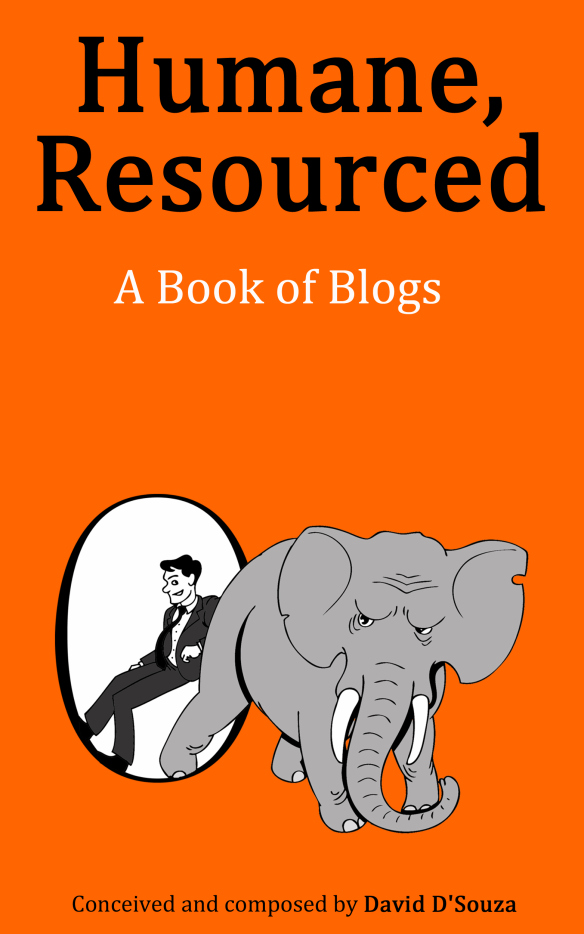
Humane ResourcedFeeling pretty awesome this morning. I can now officially lay claim to contributing to an internationally best-selling HR and Business book.

The Kindle book Humane, Resourced was released just the other day and is already climbing the charts. As of this morning, I’m told it’s at #21 for HR books in the US Kindle store and #2 in the UK. It’s also sitting at #8 for Business books in the UK. I’m sure these numbers will be out of date by the time I post this. Buy your copy now – all proceeds go to charity.

“Humane, Resourced” is a collection of contributions from over 50 business, HR, and L&D bloggers, each bringing their own unique perspectives and voices to the loose topic of people and work. Given the contributors, thought-provoking kicks to the head are inevitable:

1.    Simon Heath (@SimonHeath1)
2.    Doug Shaw (@dougshaw1)
3.    Sukh Pabial (@sukhpabial)
4.    Ian Davidson (@ianandmj)
5.    Bruce Lewin (@fourgroups)
6.    Ben Morton (@Benmorton2)
7.    Richard Westney (@HRManNZ)
8.    Lembit Öpik (@Lembitopik)
9.    Emma Lloyd (@engagingemma)
10.  Gemma Reucroft (@HR_gem)
11.  Stephen Tovey (@StephenTovey13)
12.  David Richter (@octopusHR)
13.  Amanda Sterling (@sterling_amanda)
14.  Wendy Aspland (@wendyaspland)
15.  Peter Cook (@AcademyOfRock)
16.  Julie Waddell (@jawaddell)
17.  Leticia S. de Garzón (@letsdeg)
18.  Vera Woodhead (@verawoodhead)
19.  Nicola Barber (@HRswitchon)
20.  Tim Scott (@TimScottHR)
21.  Amanda Arrowsmith (@Pontecarloblue)
22.  Inji Duducu (@injiduducu)
23.  Anne Tynan (@AnneTynan)
24.  Neil Usher (@workessence)
25.  Louisa de Lange (@paperclipgirl)
26.  Megan Peppin (@OD_optimist)
27.  Ian Pettigrew (@KingfisherCoach)
28.  Steve Browne (@stevebrowneHR)
29.  Kate Griffiths-Lambeth (@kateGL)
30.  Tracey Davison (@mindstrongltd)
31.  Jason Ennor (@MYHR_NZ)
32.  Bob Philps (@BPhilp)
33.  Kat Hounsell (@kathounsell)
34.  Simon Jones (@ariadneassoc)
35.  Mervyn Dinnen (@MervynDinnen)
36.  Alex Moyle (@Alex_Moyle)
37.  Julie Drybrough (@fuchsia_blue)
38.  Susan Popoola (@susanpopoola)
39.  Ruchika Abrol (@ruchikaabrol)
40.  Simon Stephen (@simonstephen)
41.  Damiana Casile (@damiana_HR)
42.  Honeydew_Health
43.  Malcolm Louth (@malcolmlouth)
44.  Perry Timms (@perrytimms)
45.  Sinead Carville (@SineadCarville)
46.  Jon Bartlett (@projectlibero)
47.  Jane Watson (@JSarahWatsHR)
48.  Broc Edwards (@brocedwards)
49.  Sarah Miller (@whippasnappaHR
50.  Meghan M. Biro (@MeghanMBiro)
51.  Anna Lloyd (@buggilights)
52.  Luke Thomas(@springccr)

“Humane, Resourced” was conceived, organized, and promoted by David D’Souza (@dds180) over in the UK. He gets massive kudos for making this book happen. Can’t wait to see his next project.

what if people mattered?

Imagine with me for a moment…

What if people mattered to the success of a business?

What if people were a crucial part of delighting customers and ensuring return business?

What if people were necessary to create and invent and innovate?

What if people used their experience and judgment to make decisions that affect outcomes?

What if people each had their own strengths, weaknesses, goodness, and extremes?

What if people each had their own interests, dreams, desires, and constraints?

What if people weren’t all the same and couldn’t be removed and replaced like gears on a machine?

What if people were sometimes employees, sometimes shareholders, or sometimes customers? What if they were sometimes all three at once?

What if people were complex and unpredictable and that sometimes leads to brilliance?

What if people were complex and unpredictable and that sometimes leads to disaster?

What if people had their own lives going on and didn’t live or die for the organization?

What if people weren’t all like you?

What if people were different and that difference might create strife, conflict, chaos, energy, synergy, and great leaps forward?

What if people had uniqueness that was both their biggest strength and worst weakness?

What if people were necessary to get work done?

What if people need businesses less than businesses need people?

What if people were required to interpret data and make decisions and take actions based on sound judgment, intuition, and wild guesses?

What if people invented and built all the technology that changes business?

What if people wanted to feel safe, respected, liked, and valued?

What if people made decisions and took actions based on their feelings and emotions and only used logic and reasoning to justify their decisions and actions?

What if people didn’t always act in their own best interests?

What if people sometimes do stupid things?

What if people were more loyal to people than to the initials inc., llc., gmbh., or ltd.?

What if people and the relationships they have with other people generated more business than spreadsheets?

What if people were necessary to dream up, make, deliver, and improve the products and services your business sells?

What if people were a crucial part of creating compelling messages, attracting and assisting customers, and growing the business?

We’re still just imagining here… But what if some – any – of this were actually true? What if people, in all their complex, irrational, unpredictable, humanness, were actually crucial to business results?

Would that change the emphasis on how much effort you put into finding and hiring the right people?

Would you put a different level of priority on your efforts to develop and improve the people you invested in by hiring?

Would the employee experience become important?

Or, if you knew people were actually a prime competitive advantage, would you pretend they weren’t and spend your time, energy, and money on other things?

(re)thinking the future of work

“Look, if you had one shot, or one opportunity to seize everything you ever wanted; one moment. Would you capture it or just let it slip?” ~ Eminem from “Lose Yourself”

“The future is scary when you don’t feel you have any control. The future is exciting when you feel you are creating it; it’s threatening when you want things to stay the same (or go back to being how they were); it’s liberating when you see how it could be even better than today.” ~ Participant’s comment from The Frontier Project: The Future of Human Resources


You have an opportunity. A chance worth taking. A moment to come together with others who are ferociously passionate, smart, curious, insistent, pioneering, wondering.

I’m fascinated by the FutureNow of work. The seeds and sprouts of the inevitable(?) changes disrupting how we’ve always thought about jobs and organizations are there taking root and starting to grow. Technology shrinks, twists, and alters “how we’ve always done it.” Socioeconomic schisms have been opened up by tectonic shifts in the economy. Organizational structures, once certain, are being shoved aside in the quest for something better. The curtain has been pulled back revealing the illusion of control. And us humans keep being humans in all our rule bound sloppy illogically rational educated ignorance. History repeats with a fresh coat of paint and a different pattern of wall paper. Change keeps on changing. Round and round she goes, where she stops…

It’s overwhelming. But what if you could get ahead of the curve? What if you could be a part of creating the future instead of wondering, worrying, and letting it wash over you?

Talent Anarchy is at it again, shouldering their way to the forefront of disruptive thought with The Frontier Project: The Future of Work. Jason Lauritsen and Joe Gerstandt have set aside some space and time near Houston in November for a diverse group of folks to come together and think, consider, wonder, and debate the Future of Work. Jason and Joe will be setting up the framework, then poking, prodding, and asking questions, but the real work and the answers will come from the group.

So here’s your opportunity. The Frontier Project is a “think tank on steroids” (in Jason’s and Joe’s words) designed to push buttons, challenge assumptions, get past the here and now, and play with what could/should/will be. It’s a chance for you to look to the future and (hopefully) come away with some very real ideas for what to do right now.

This isn’t a training, conference, or seminar. If you crave certainty and finely crafted bullet point lessons this event is not for you. There are no foregone conclusions, inevitable solutions, guarantees where the discussion will go, or certainty where the answers will come from.

As a reader of this blog you know I’m a friend and fan of Talent Anarchy. They’ve asked me to help get the word out about the event – something I’m more than happy to do because I’m excited to attend and looking forward to what comes next. I’m inspired by Jason and Joe’s intensely thought provoking irreverence, rejection of business as usual, and the challenge they’ve laid to the world to embrace our authentic humanness. They are continually thinking bigger and have extended an invitation to join them.

I hope to see you there. The future’s coming fast and we all have work to do.

high performance disengagement

I’ve been trying to go to the gym a bit more regularly lately, not that that’s unusual. Compare the number of gym memberships to the number of people who consistently go to the gym and it’s safe to assume that almost all of us are trying to go to the gym a bit more regularly lately.

That said, there are regulars – folks with impressive self-discipline and dedication who show up nearly every day. But, not all regulars are the same. The majority are focused and pushing themselves through workout after workout. Some are really fit and some are trying to get there, some are young, some old(er), some men, some women.

Look close, though, and there is a second group of regulars. I find this second group really interesting.

It’s always guys, mid to late 20s, who look superfit. Lean and muscular, you’d think they give their all every day. But… they don’t. They do a set of weights, then they get a drink at the fountain. They walk around. They chat with others. No sense of urgency, no sense of purpose, and no apparent plan. If they actually get a workout in it must take four times longer than necessary. Yet, even though they don’t appear to workout hard (if really at all) there are two crucial points to remember: 1) they are at the gym religiously; and 2) they are clearly very fit. What’s happening here?

My best guess is they played sports in high school and college, built up a fantastic physique with coaches and teammates pushing them forward, continue to eat pretty healthy, and with the metabolism of a 20-something are able to maintain their fitness without too much effort. Today, the gym is a part of their lives so they show up, but they’re really coasting on past effort and yesterday’s success.

Sound like anyone you know at work?

I’m really intrigued by the idea of high performers who become disengaged and are now just going through the motions. Chances are, they are still performing higher than average, just far below their potential and past performance. I guess what interests me is that most of the high performers I’ve known have moved on to other companies when disengagement started to set in. They were curious, focused, and had an enormous desire to do great work. If that wasn’t possible, if they felt hemmed in or started to get bored or became cynical about the company, they were gone. On to the next exciting opportunity.

So why would a disengaged high performer stick around? Why would they start pursuing mediocrity instead of excellence? Why would they stay in a position where they weren’t able (for whatever reason) to give their best instead of actively seeking a situation where they could? And if they have become ok with disengagement, why keep pretending to be committed instead of giving up entirely? Remember, we’re talking about high performers with established track records – they have options, they could change jobs – so they’re not just gutting it out because they have to.

I’ve lots of thoughts, but what thinks you?

 
Photo Credit: Patrick Feller via Compfight cc